The UPF of Common Summer Fabrics—What Science Actually Shows
Short answer: Most everyday summer fabrics provide far less UV protection than people assume. Scientific studies consistently show that fiber type, weave density, thickness, and dyeing determine UPF—not just whether something is “natural” or “lightweight.”
This guide breaks down the actual UPF performance of common summer fabrics, based strictly on peer-reviewed textile and dermatology research.
Why fabric matters more than you think
A foundational study published in BMC Dermatology analyzing 236 commercial summer fabrics found:
- 33% had UPF below 15 (insufficient protection)
- Only 48% met UPF 30+ (recommended protection level)
The key takeaway: most summer clothing is not inherently protective.
Cotton: widely worn, often low protection
Cotton is one of the most common summer fabrics—but also one of the most inconsistent in UV protection.
What research shows:
-
- Undyed cotton fabrics often have UPF below 15
- Lightweight cotton (especially plain weave) may provide minimal protection
- Protection increases with:
- Heavier weight
- Tighter weave
- Darker dyes
A textile study found that fabric weight and thickness strongly correlate with higher UPF, meaning heavier cotton performs significantly better than lightweight versions .
What this means in practice:
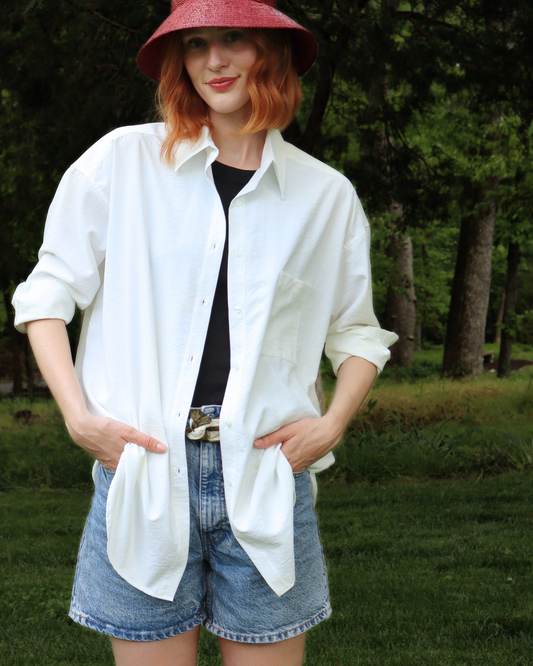
A thin white cotton shirt may offer very little protection, while a dense cotton twill can perform moderately well.
Linen (Flax): breathable, but weak UV barrier
Linen is often associated with summer due to its breathability—but structurally, it tends to underperform in UV protection.
Scientific findings:
-
- Linen and flax fabrics frequently fall into lower UPF categories (<30)
- Like cotton, undyed linen provides poor UV protection due to:
- Loose weave structure
- Lower fiber UV absorption
Why:
Linen fibers are stiff and woven with more space between yarns, increasing UV transmission through gaps.
Bottom line:
Linen is comfortable—but not reliable for sun protection without treatment or dense construction.
Polyester: consistently high UV protection
Polyester is one of the most effective fibers for blocking UV radiation.
What studies show:
-
- More than 70% of polyester fabrics achieved UPF 30+
- Polyester outperforms cotton due to its chemical structure, which absorbs UV radiation more effectively
- Comparative textile studies show higher UPF values in polyester vs. cotton fabrics
Why:
Polyester’s molecular structure contains aromatic rings, which naturally absorb UV radiation.
Bottom line:
Polyester provides reliable baseline protection, especially when tightly woven.
Nylon: high performance, similar to polyester
Nylon performs similarly to polyester in UV protection, often with slightly better results in some constructions.
Scientific findings:
-
- Nylon fabrics show higher UPF than cotton in controlled textile testing
- Performance improves with:
- Fabric density
- Layering or knit structure
Why:
Nylon’s UV-stable polymer structure allows it to absorb and block UV more effectively than many natural fibers.
Bottom line:
Nylon is a strong UV-blocking fiber, especially in performance or tightly constructed fabrics.
Wool and blended fabrics: surprisingly strong performers
Although less common in summer, wool and fabric blends often perform well.
Research findings:
-
-
Over 70% of wool and blended fabrics achieved UPF 30+
Why:
-
- Natural crimp and fiber structure increase light scattering
- Often woven more densely
Bottom line:
These fabrics are less typical for hot weather but are inherently more protective.
The role of dye, color, and finishing
One of the most overlooked factors in UV protection is dyeing.
Scientific findings:
-
- Dyeing cotton significantly increases UPF, especially with darker shades
- Higher dye concentration = higher UV absorption
Additionally, UV-blocking finishes (e.g., titanium dioxide or zinc oxide additives) can further increase protection .
Why it matters:
A dyed fabric can perform dramatically differently than the same fabric undyed.
Fabric construction matters more than fiber
Across all studies, one conclusion is consistent:
Fabric structure often matters more than fiber type alone.
Key drivers of UPF:
-
- Weave density (cover factor)
- Thickness and weight
- Porosity (space between yarns)
- Stretch and wetness conditions
Even high-performing fibers can underperform if the fabric is too thin or loosely woven.
A realistic hierarchy of common summer fabrics
Based on peer-reviewed evidence, typical performance trends look like:
Higher protection (more consistent):
- Polyester
- Nylon
- Wool blends
Variable (depends heavily on construction):
Lower protection (unless engineered):
- Linen (flax)
- Viscose/rayon
The bigger takeaway
The most important insight from the research is this:
You cannot judge UV protection by how a fabric looks or feels.
- Lightweight ≠ breathable ≠ protective
- Natural ≠ safer from UV
- White ≠ protection
UPF is the result of engineering, not assumption.
Where this leaves everyday clothing
Most summer wardrobes are built around:
- Lightweight cotton
- Linen
- Loose silhouettes
From a UV standpoint, these are often the least protective combinations, especially in strong sun.
This is why purpose-built UPF fabrics exist—they are designed to balance:
- Protection
- Weight
- Wearability
Final thought
Sun protection from clothing isn’t about choosing a “type” of fabric—it’s about understanding how that fabric is made.
Because in real terms, the difference between a UPF 5 shirt and a UPF 50 shirt isn’t subtle—it’s the difference between blocking most UV radiation and letting a meaningful amount reach your skin.
Sources
- Sarkar, A.K. BMC Dermatology — UV protection of dyed cotton fabrics
- Gambichler et al. BMC Dermatology — UV protection of 236 summer fabrics
- Sarkar et al. BMC Dermatology — Fabric construction and UPF relationships
- Anas et al. Textile Research Journal — Comparative UPF of cotton, nylon, and synthetics