Why Summer Fabrics Like Cotton and Linen May Not Block UV Rays Well
Share
Cotton and linen are popular summer fabrics because they're lightweight, breathable, and comfortable—but that doesn't necessarily mean they provide good UV protection. In fact, studies of commercial summer clothing have found that many lightweight cotton and linen fabrics have relatively low UPF ratings.
That's because how a fabric protects against UV radiation has less to do with its name—cotton, linen, polyester, or otherwise—and much more to do with how the fabric is constructed.
Lightweight Doesn't Always Mean Sun Protective
The same qualities that make a summer fabric feel cool and comfortable can sometimes work against UV protection.
Lightweight fabrics are often made with a more open construction that allows air to move through the garment. But those spaces between fibers and yarns can also allow more UV radiation to pass through.
In one study of 236 commercial spring and summer fabrics, only about 30% of the cotton, linen, and viscose fabrics tested had a UPF of 30 or higher. Overall, one-third of all the summer fabrics tested had a UPF below 15.
That doesn't mean cotton or linen can't provide good UV protection. It means you can't assume a fabric is sun protective simply because it's a particular fiber.
What Actually Determines UV Protection?
A fabric's ability to block UV radiation depends on several factors, including its density, thickness, weave or knit, color, fiber characteristics, and overall coverage.
Research has consistently found that fabric construction and coverage have a major influence on UPF. A study of summer textiles found that the amount of fabric coverage was one of the strongest factors influencing UV protection.
This is why two white cotton shirts can provide very different levels of protection. The same applies to linen.
A heavyweight, densely woven linen fabric can provide considerably more UV protection than a lightweight, loosely woven linen shirt. The fiber itself doesn't tell you the UPF.
Why White Summer Clothes Can Be Deceptive
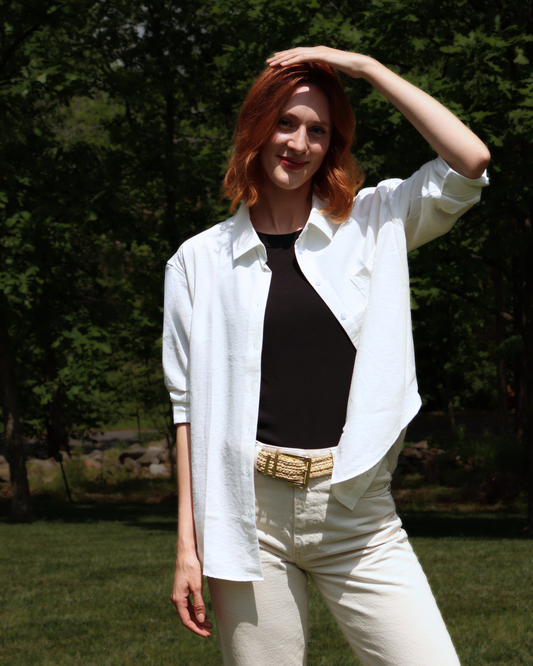
White and light-colored clothing can feel like the obvious choice for a hot, sunny day. But color is only one piece of the equation.
Research has found that darker or dyed fabrics can provide greater UV protection than undyed or lightly colored fabrics, although the effect varies depending on the fabric and construction.
That creates a common misconception: a shirt can look substantial enough to provide coverage while still allowing significant UV radiation through.
If you can easily see sunlight through a lightweight fabric, that's a reason to question how much UV protection it actually provides—but appearance alone still can't establish a UPF rating.
What About Linen?
Linen has many qualities that make it appealing in warm weather, but “linen” isn't a UPF rating.
A loosely woven linen shirt may allow considerably more UV radiation through than a densely woven linen fabric. The same is true for cotton, rayon, silk, and other common summer textiles.
If sun protection is a priority, look for a garment with a specific UPF rating, rather than assuming a particular natural fiber will provide sufficient protection.
The Bottom Line
Cotton and linen aren't inherently poor at blocking UV radiation. The problem is that many lightweight summer versions aren't constructed with high UV protection in mind.
If you want clothing specifically designed for sun protection, look for a tested UPF rating—ideally UPF 50+—rather than relying on the fabric name, color, or weight alone.
At Some Sun, we approach fabric differently. Our goal is to combine the cotton-feel and linen looking aesthetic qualities you want from summer clothing with tested UPF 50+ protection, so you don't have to guess how much protection your clothes provide. See some of our bestselling UPF.
Sources
- Gambichler et al., Protection against ultraviolet radiation by commercial summer clothing: need for standardised testing and labelling, BMC Dermatology.
- Aguilera et al., New advances in protection against solar ultraviolet radiation in textiles for summer clothing, Photochemistry and Photobiology.
- Majumdar et al., Engineering of cotton fabrics for maximizing in vitro ultraviolet radiation protection, Photodermatology, Photoimmunology & Photomedicine.
- Davis et al., Clothing as protection from ultraviolet radiation: which fabric is most effective?, International Journal of Dermatology.